






What if you could learn English three times faster? You can understand a few key concepts. Many learners struggle because they choose more advanced methods, such as focusing on grammar rules for months before speaking. This pursuit of perfection delays real conversation. To improve your English quickly, schedule learning sessions, immerse yourself in English, and pay . Move beyond textbook methods by applying cognitive science and focusing on the most frequent vocabulary.
These strategies aren't limited to English alone. In fact, once you understand them, you can adapt and apply the same approaches when mastering other languages. Let's find out how to learn English fast, save time and effort, and achieve better results!
#1 Set Specific Goals to Learn English Faster
Being strategic helps you learn English faster. Why? Clear goals are easier to track and keep you focused. Specific goals let you set and reach milestones, fueling your progress. So the sooner you define your goals, the sooner you can achieve them.
First, identify your starting point and your target, such as moving from B1 to B2 in six months. Then break the main goal into actionable steps, so you know how much to practice every day.
Use the CEFR framework to determine your current proficiency level. Official documentation lists the competences for each level. First, estimate your level. Second, note the language skills needed for the next level. Both steps help estimate effort and set a realistic timeline.
If you have a specific learning goal, such as preparing for a conference, job interview, vacation, you can make a list of conversation topics to practice. For a vacation, that would include booking a hotel, speaking on the plane, ordering food at a restaurant, asking for directions, and more. That way, you can personalize learning and focus your English speaking practice on what matters most.
#2 Learn the Core Vocabulary
You can memorize thousands of words in English and still fail to order coffee. That's because you need to learn the right words first. While native speakers recognize around 35,000 words, they only use a fraction of them in daily communication. So, instead of learning random vocabulary, focus on the curated list of the most frequently used English words - Oxford 3,000. Learn them first to avoid months of frustrations.
The Oxford 3000 lists the most used English words, from A1 to B2. This vocabulary is a strong base for daily situations. The list is curated by experts to help learners have basic conversations with a limited vocabulary. That way, you build a strong base before learning specialized vocabulary.
How can you learn the core vocabulary? Start by picking up 10 words daily, for instance. Spend two minutes reading the definition and a couple examples. Review yesterday's 10 before adding new ones. That way, at 10 words a day, you can cover the full Oxford 3,000 list in less than a year. If you learn 20 words daily, you finish it in five months.
#3 Train Your Brain with Microlearning
Research shows language learning is more efficient in short daily bursts compared to longer sessions. Microlearning is a focused 10-minute lesson on a single goal. Compared to hour-long sessions a few times weekly, short lessons help learners focus and remember, preventing overload. ESL learners focus better, learn more easily, and see better results.
There are many ways to integrate microlearning into your busy schedule. A few examples are listed below.
1. The vocabulary sprint. Take a list of new words or a pack of flashcards you need to review and practice for 10 minutes. The key here is to be consistent and practice daily.
2. The song master. English songs are excellent at adding new vocabulary words to your word bank. You can listen to music and write the lyrics you hear, then look them up online and see if you got everything right. That is a great exercise to train your listening skills, and lyrics can help learn phrasal verbs or understand complex grammar.
3. One grammar rule. If you need to learn grammar or you often make the same mistake, spend one minute learning the rule and nine minutes practicing.
To keep learning interesting, you can alternate exercise types in a weekly rotation, depending on your needs.
#4 Immerse Yourself Without the Plane Ticket
Everybody knows the best way to learn English is to move to a country where it is the native language and interact with locals. That's immersion. However, you don't need to live in London or New York to speak English. You can adapt immersion to learn English from the comfort of your home. Some examples are as follows:
1. Surround yourself with background English. Keep English podcasts or TV shows on while you do tasks that require low focus, such as chores or showers. You will notice your English skills improve, as your brain picks up sounds, word and sentence stress, and more.
2. Scan news articles in English. Even if you do not know every word, look at the title and go over the content. This trains your brain to tolerate a certain level of ambiguity and still understand the main ideas.
3. Follow instructions in English. For a recipe, look it up and follow along in English. If you do pilates, use an English-speaking instructor. This links new vocabulary to actions, making it more memorable.
Immersion doesn't necessarily mean moving abroad. With all the information you need at your fingertips, you can include English in your daily life without leaving the house. Try one of the methods above today and see how it works for you.

Speak a new language with confidence!
Build fluency faster with FunEasyLearn — just 10 minutes a day is enough to make real progress.
#5 Master English Pronunciation
Learning English vocabulary requires learning pronunciation too. Since English isn't phonetic, identical letters can make different sounds. To speak fluently, pronunciation is essential.
- Imitate native speakers to sound fluent. Shadowing is a powerful tool. Just listen to a sentence or short paragraph, then repeat it closely. You will get more fluent Songs are also great for improving pronunciation.
- Learn the IPA (International Phonetic Alphabet). The IPA is a standardized set of symbols that tells language learners how words are pronounced. Each symbol stands for a sound. Once you understand how to use the phonetic alphabet, you can read any word in a dictionary correctly. It's a powerful tool, especially relevant if you plan to move to higher levels that use longer, more complex words.
- Practice minimal pairs. English has words that differ by just one sound. Practicing them side by side helps avoid confusion. To practice short and long "i":
| [ɪ] | [iː] |
|---|---|
| sit | seat |
| bit | beat |
| ship | sheep |
#6 Learn English in Chunks
Every sentence you make in English is an exhausting process in your head. You need to choose the words, use the correct tenses, and pronounce everything right. You can safe some energy and time by learning groups of words that usually go together. Linguists call them "lexical chunks" and you've definitely heard them before. Some examples include "by the way" or "I'll get back to you." Native speakers use them daily, and your brain treats them as ready-made building blocks. Use them to shortcut your way to sounding natural.
More examples that you can use in daily conversations include the following:
- Changing the topic: "By the way," "Speaking of which"
- Buying thinking time: "Frankly speaking," "For what it's worth"
- Agreeing softly: "Fair enough," "I see what you mean"
- Adding nuance: "On the other hand," "In fact"
One thing to remember is that lexical chunks don't translate as word-for-word expressions.
#7 Learn Hundreds of Words at a Time
What if you could learn more words at a time without extra effort? That's possible if you know what words are made from. Mastering some of the most popular suffixes, prefixes, and roots adds hundreds of words to your vocabulary base.
In linguistics, breaking words into parts is called "Morphological Analysis," and it is useful for advanced and academic English. Learning these patterns, you develop "morphological awareness," which means you can deduce the meaning of words based on their parts. See some common examples below.
| Category | Word Part | Meaning + Examples |
|---|---|---|
| Prefixes | un- | not (unhappy, unlock) |
| re- | again (redo, revision) | |
| dis- | opposite (dislike, disagree) | |
| pre- | before (predict, prepare) | |
| in- / im- / il- / ir- | not (inactive, impossible) | |
| Suffixes | -tion / -sion | action (education, prediction) |
| -ment | result (development) | |
| -able / -ible | capable of (readable, visible) | |
| -ness / -ity | state of (kindness, clarity) | |
| -ize | to make (modernize, realize) | |
| Roots | vis / vid | see (visible, television, revise) |
| dict / dic | say (predict, dictionary, contradict) | |
| port | carry (transport, import, portable) | |
| struct | build (construct, destruction) | |
| aud | hear (audience, audio) |
Let's assume you see the word “inaudible” and don't know what it means. We'll decode it together. "In-" is a prefix, just like "im-/il-/ir," meaning "not." The root word is "aud," and it means "hear," as in "audio." The last part of the word is the suffix "-ible", which stands for "capable." So, connecting all the elements of the word "inaudible," we can conclude that it means something that cannot be heard.
Learn English with FunEasyLearn
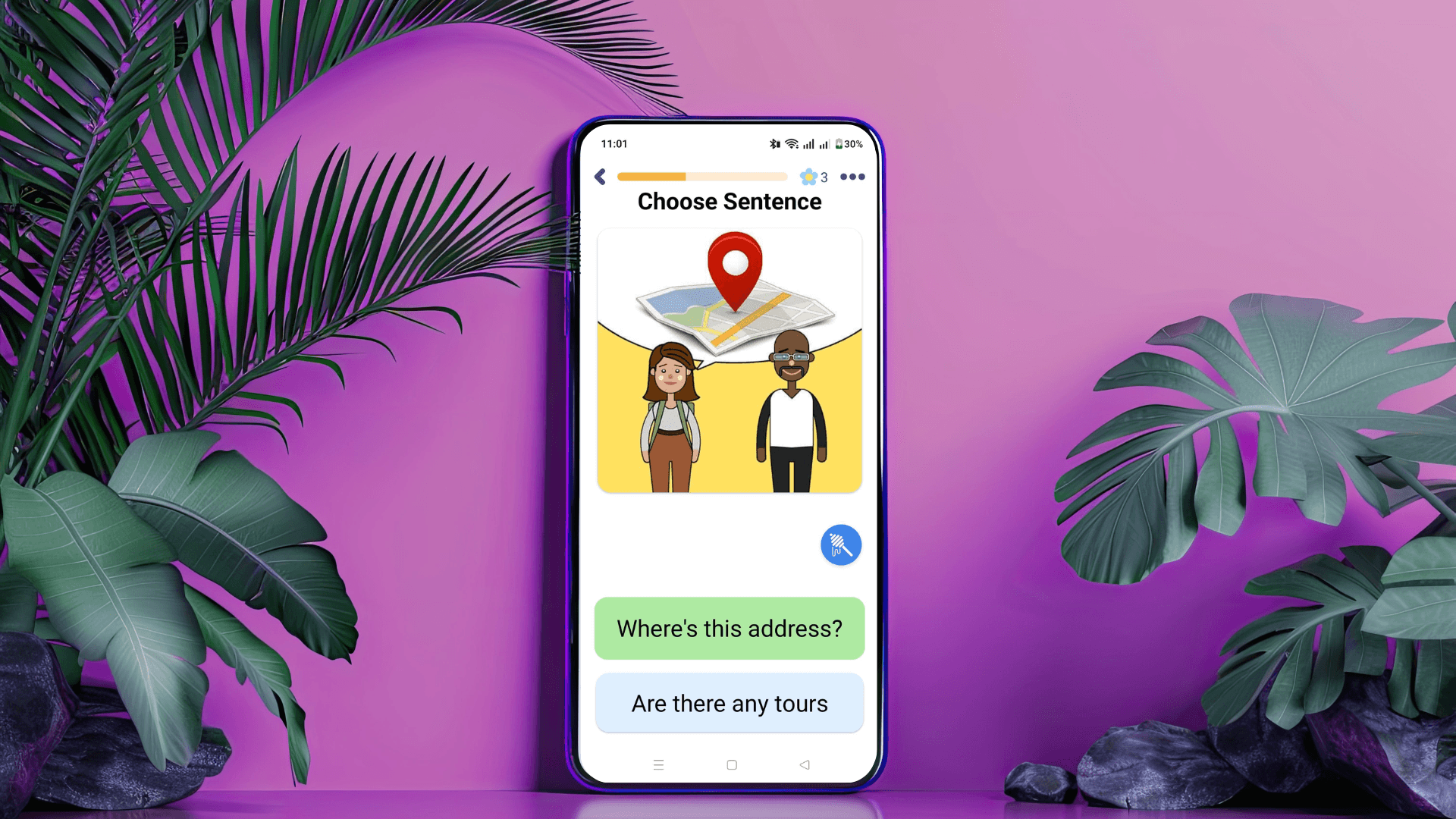
If you don't have time to build a custom learning plan from scratch, get FunEasyLearn. The app offers a ready-made system based on the same principles in this article. Designed around the principles of the Lexical Approach , FunEasyLearn teaches you words in context through sentences and chunks rather than isolated vocabulary. You can choose the British and American English, and more than 30 other language courses.
It teaches you how to say it. Every word includes native-speaker audio recorded in professional studios. Activate IPA transcription to see exactly how a word is pronounced, even when you cannot listen.
It teaches you what to say. Beyond individual words, the app teaches 6,000 sentences and lexical chunks that native speakers use daily. Explore 5,000 words across 350 topics built for real conversations.
It fits your schedule. Short daily lessons align with the microlearning approach. Ten minutes of daily practice builds vocabulary without overwhelming you. Most learners need about a month to automate the habit of language learning.
Planning to improve your English?