






Have you ever struggled to memorize or recall vocabulary in a new language? That is one of the most frustrating experiences language learners go through. The thought of memorizing more with less effort is incredibly appealing to learners of all ages. And for good reason! Learners from various fields, along with polyglots, use the principles of spaced repetition to memorize new information faster and improve retention.
What Is Spaced Repetition?
The spaced repetition system (SRS) is a learning technique that focuses on reviewing new information at specific time intervals to dramatically improve long-term retention. When learning a language, you may think that the more you review the new words, phrases, and sentences, the better you will memorize them. However, extensive research revealed that strategically reviewing vocabulary or other concepts at longer intervals is far more efficient.
The spaced repetition system (SRS) is a learning technique that focuses on reviewing new information at specific time intervals to dramatically improve long-term retention. When learning a language, you may think that the more you review the new words, phrases, and sentences, the better you will memorize them. However, extensive research revealed that strategically reviewing vocabulary or other concepts at longer intervals is far more efficient.
In a nutshell, spaced repetition works by presenting recently learned or difficult items more frequently, and older or easier items less often. Over time, this practice optimizes the transfer of information from short-term to long-term memory. And that's how you memorize more words by working less.
The Benefits of Spaced Repetition
Reviewing new information at optimal intervals proved to be an efficient learning method. The practice essentially reminds you of the concepts or vocabulary you are about to forget.
Studying with the spaced-repetition method has multiple benefits, including the following:
- Improved long-term retention. Studying a foreign language, coding, or anything else with spaced-retrieval training outperforms traditional study habits like cramming. As a result, the material reviewed with SRS is more likely to be remembered weeks, months, or even years later.
- Optimized learning. As you memorize more, you don't need to spend more time studying everything, saving both time and effort.
- Lowered mental overload. Trying to memorize large volumes of information may lead to burnout. Spaced study sessions are easier on your brain compared to long cramming sessions.
- Better recall of difficult items. With a spaced repetition schedule, you focus more on the items that are harder to memorize. Repeated exposure to difficult-to-remember words or concepts helps your brain memorize them.
- Improved memory. The more you learn, the more you train your memory. From the first study session, you not only complete your learning tasks but also develop a study habit with multiple cognitive benefits. One of the perks is better memory.
- Better understanding of information. The more you review the material, the more details you notice, helping you connect the new piece of information with what you already know. These bonds ensure long-term memory and easy retrieval of the information needed.
- Subject versatility. The application of spaced repetition spans from vocabulary, facts, formulas, new skills, and much more.
- Higher motivation. Shorter study sessions feel more manageable, reducing stress and frustration.
Overall, using gradually increasing intervals to review new information supports steady, long-term learning, helping you retain more, avoid cramming, and build a healthier, more sustainable study routine.
A Brief History of Spaced Repetition
The concept of spaced repetition may sound like a modern buzzword, but it is almost 150 years old. Surprisingly, the research began with early scientific investigations into forgetting.
The Foundation set by Ebbinghaus
Hermann Ebbinghaus, a German psychologist, is often associated with spaced repetition for his groundbreaking studies of human memory. Ebbinghaus developed the Forgetting Curve, which demonstrated the human brain's tendency to forget new information following a predictable pattern. In other words, learners forget at about the same rate unless they review the information within a few hours or days.
The findings on memory loss led to further research on the spacing effect, or the practice of reviewing information at spaced intervals to improve retention and retrieval. The most important conclusion here is that repetition learning, or short, spaced reviews, helps you recall information and is far more efficient than long, uninterrupted sessions. Ebbinghaus's main contribution was proving that timing and repetition are critical to memorizing.
Testing in Language Classrooms
In the early 1990s, educators began using spaced-repetition practices in the classroom. The concepts were particularly attractive to language teachers, who noticed better retention when students reviewed vocabulary over days or weeks. They used a set of flashcards organized into two piles: one for words the student knew well, scheduled for later review, and one for those they had a hard time remembering and needed to review sooner. That simple system would later inspire the SRS methods used to this day.
The Leitner System
The review sessions were improved by the German science journalist Sebastian Leitner in the 1970s. He organized the learning process using boxes. More specifically, he suggested using two boxes with flashcards. All new flashcards start in the first box. When practicing, you place a card you know into the "review later" pile. If you get it wrong, the card goes back to the first box, which is reviewed more often.
The Leitner System ensured effective learning by focusing the learner's efforts where they are most needed. That way, students could recall the information more easily while also reducing study time. To this day, the Leitner System is widely used and considered the basis for many SRS techniques.
The First Spaced Repetition Algorithm
Computers revolutionized spaced repetition learning. In the 1980s, Polish researcher Piotr Woźniak began seeking algorithms to optimize a typical spaced-repetition schedule. His work led to the creation of the first spaced-repetition software, SuperMemo, which calculated optimal review intervals based on user performance. That's how spaced learning became more dynamic and accurate for each learner. The software became the gold standard that influenced the development of spaced repetition apps.
Backed by a long history of testing and refinement, the principles of spaced repetition are widely used in education, especially for language learning.
Spaced Repetition Time Intervals
If Ebbinghaus established that the forgetting curve is predictable, why are there several algorithms to calculate spaced repetition? While it would be great to have one format that suits everybody, each learner has their own preferences, pace, and memory patterns. Memory is a complex process shaped by countless factors—attention, prior knowledge, emotional state, sleep quality, and even the type of material being learned. The forgetting curve shows a general trend, but it doesn’t account for these individual variables. For that reason, incorporating spaced repetition into your learning strategy depends on which model better suits you.
Some of the most popular algorithms include the following:
- The 2, 3, 5, 7 method. After the first day of study, summarize the information and create effective flashcards. Review the information the next day, then the third day, the fifth day, and finally after one week. When preparing for an exam, calculate the number of days until the exam date.
- The 1, 7, 16, 35 method. Another popular study method uses intervals from day one to day 35. This algorithm is popular with learning apps.
- The 1, 6, 14, 30, 66, 150, 360 method. This review template spans a more extended timeframe and is ideal for information you need to understand thoroughly. Some practical applications include materials indispensable in one's job.
The beauty of the spaced repetition method is that you can adjust it to your learning style. For instance, you can start your spaced retrieval training by writing flashcards or creating digital versions. For language learning, you can try memorizing vocabulary on a few topics using the 2, 3, 5, 7 method, then slightly adjust the formula.
Learn Better with FunEasyLearn
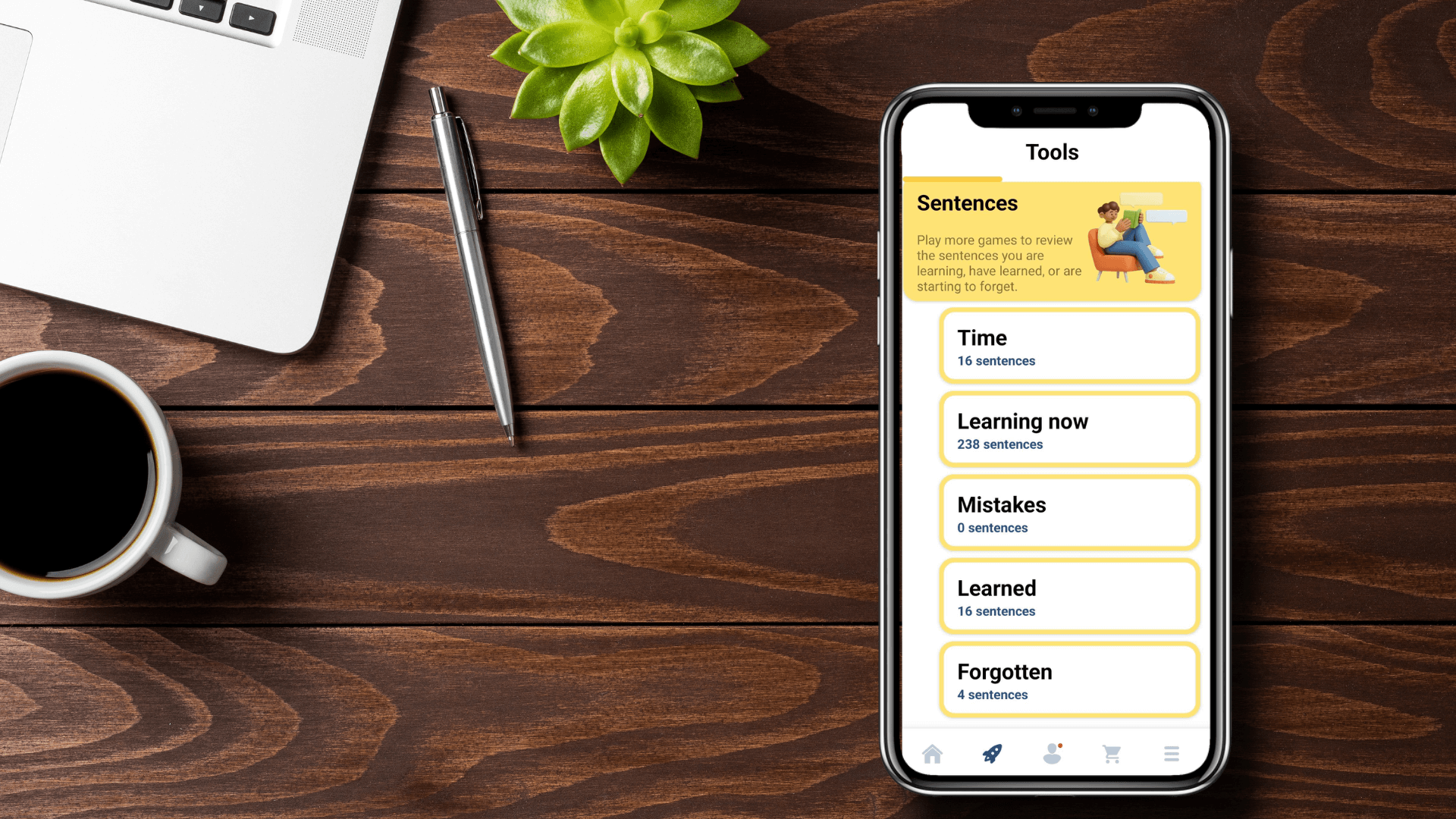
FunEasyLearn uses the principles of spaced repetition to help you remember vocabulary for the long term. The app's premium feature, Review, automatically groups your words and sentences into different review categories, so you always know what needs your attention. These include:
- Time – words and sentences learned today, last week, last month, or several months ago.
- Learning now – items you started learning but haven’t completed yet.
- Mistakes – anything you answered incorrectly in a game.
- Learned – vocabulary you completed successfully in all games.
- Forgotten – content you haven’t reviewed for a set period (7, 14, 21, 30 days, etc.).
By cycling through these categories at the right time, FunEasyLearn helps you strengthen your memory, stay organized, and make steady progress—without the stress of planning your own study routine.
Are you ready to learn smarter, remember more, and speak a new language fluently?