




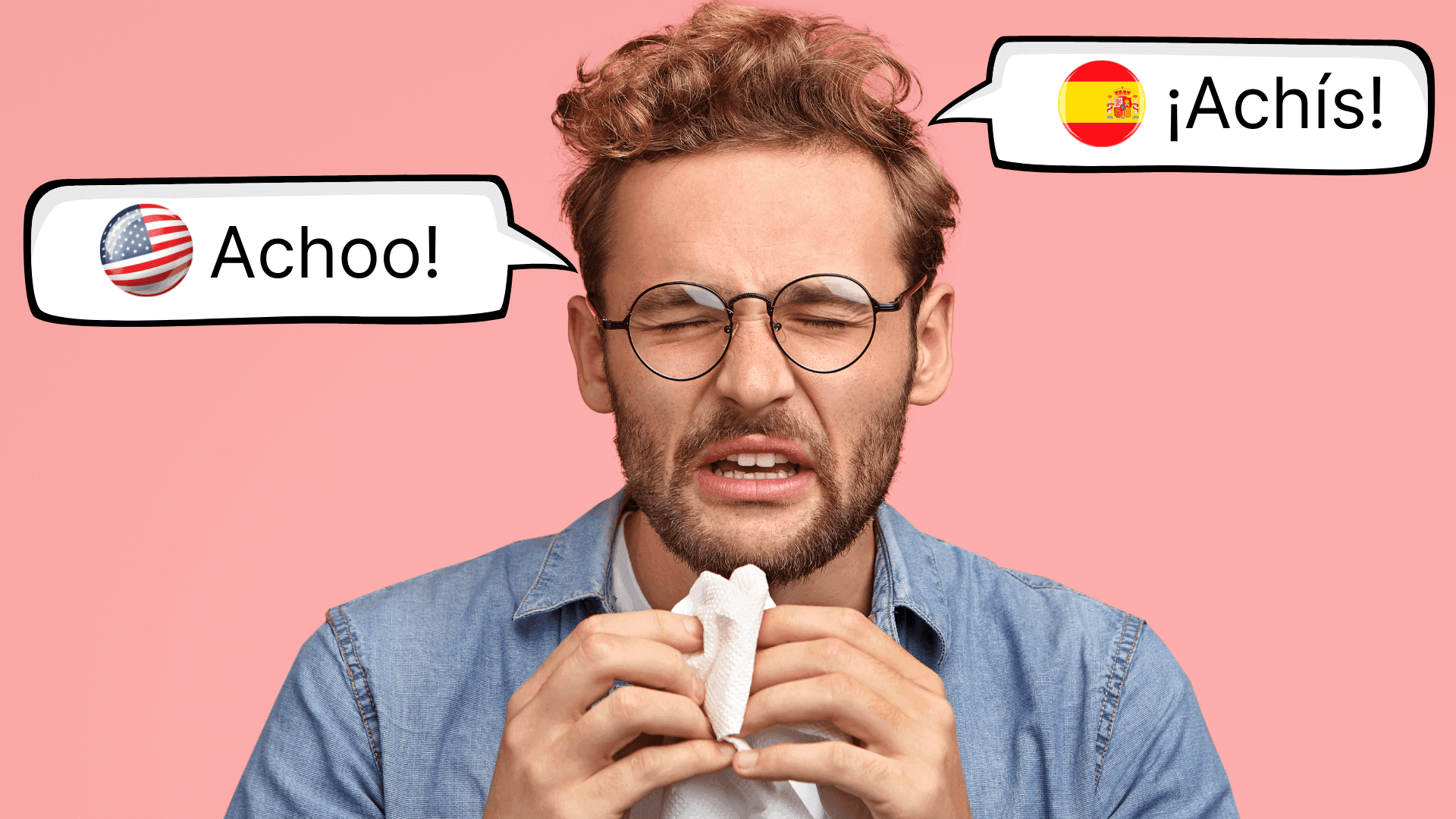
Picture yourself walking on the uneven streets of Barcelona, on cobblestones, sudden hills, and you get to a dead end. You ask a local to help you out, and while he's trying to show you the way on the map, you hear a loud "Achoo!" and your first instinct is to say "Bless You!" However, that exact word is missing from your vocabulary. Does that mean you still need to learn Spanish and pay more attention to cultural nuances? That's actually a great idea. After all, a foreign language is complex, and it's absolutely normal for a learner to keep updating their vocabulary. Let's learn together how to say "Bless You" in Spanish, and you may be surprised, but it's more than a one-size fits all situation.
¡Salud!
You may often hear "¡Salud!" after someone sneezes. Translated as "I wish you good health!" "¡Salud!" is almost an equivalent to the English "Bless You." It's widely used in Spanish-speaking countries, especially in Latin America. In Spain, you may encounter a few regional variations.
Another context to use "¡Salud!" is when clinking glasses. In fact, that was the original situation where raising a glass was accompanied by a heartfelt "To your health!" or the equivalent of "Cheers!" The custom comes from medieval Europe, back when people believed wishing someone good health would keep them safe from bad spirits and illness. "¡Salud!" has evolved to wish someone health when they sneeze.
¡Jesús!
If you're looking for a religious alternative to "¡Salud!," you can use “¡Jesús!” Translated literally as "Jesus" and widely used in Spain by Catholics. Of course, it's more common among older, more religious speakers. In Latin American countries, you will hear "¡Que Dios te bendiga!” or "Dios te bendiga" (May God bless you / God bless you!) as a response to a sneeze. Again, these phrases are favored by more religious speakers.
Historically, the sneeze was considered a moment when the soul might escape. Saying “Jesús” was one way to ask for protection and prevent the devil from entering the body of the person sneezing. The exclamation thus serves as a short prayer.
One interesting variation consists in using "Jesús, María y José" in a sequence, for the case when a person sneezes more than once, each of the three sneezes gets a new exclamation, forming the religious triad also known as "The Holy Family." This version is thought to add more power where more help is needed.
¡Salud, dinero y amor!
The above-mentioned option "Jesús, María, y José" is not the only progressive blessing system. In some parts of Latin America, such as Mexico, for example, people say "¡Salud!" (Health) after the first sneeze, "¡Dinero!" (Money) for the second sneeze, and "¡Amor!" (Love) after the third one. Although common and fun, not everybody does this. The extended blessing has a full version "Salud, dinero y amor... y tiempo para disfrutarlos," which translates as "Health, money, and love… and time to enjoy them." So, instead of only wishing a person health, the speaker launches an entire set of wishes, spanning from good health to financial wellbeing, and romantic love.
The "¡Salud, dinero y amor!" formula is more common in informal contexts, among close friends and family members. Although warm in nature, the phrase carries a subtle teasing tone, so be cautious about using it with strangers.
What happens if the person sneezes a fourth time? What Spanish phrases are used in that case? The tradition takes a humorous turn with one of the following sentences:
- "¡Eso ya es gripe!" or "¡Eso ya es gripe, vete de aquí!" (That’s already the flu, get out of here!);
- "¡Ya basta!" (Enough already!);
- "¡Cuídate, que eso ya no es normal!" (Take care, this isn’t normal anymore!).
¡Atchís!
Other than the sound one makes when sneezing, "¡Atchís!" is also a playful response to the same action. The name of the sound comes from French "atchoum," as per Real Academia Española (REA) dictionary. The response is common in informal Latin American contexts like family teasing or comedy, and it adds humor instead of a blessing. In Spain, a milder "Achís!" variant appears, but Latin America's version adds exaggeration for humor.
Use "Atchís!" with close friends or kids to avoid seeming rude. Pair it with a grin for best effect. It offers a more fun alternative to "Salud!" without religious overtones.
God Bless You
If you want to use a phrase closer to the English "God Bless you" with a religious undertone during a conversation, opt for "Dios te bendiga" or "Que Dios te bendiga" when directly addressing a friend. Since the phrase uses the informal address "tu", it's recommended to avoid it in formal contexts, especially if you don't know whether the person is ok with religious wishes.
In formal settings, use "Dios lo bendiga" when speaking to a man, "Dios la bendiga" for a woman, or the neutral "Dios le bendiga." That way, you keep the religious warmth without crossing into overly familiar lingo.
When more people sneeze, refer to the options below:
- "Dios les bendiga" (neutral plural)
- "Dios los bendiga" (used to refer to a mixed group or all men)
- "Dios las bendiga" (when addressing to a group of all women)
- "Dios os bendiga" (used in Spain for the informal plural "vosotros")

Speak a new language with confidence!
Build fluency faster with FunEasyLearn — just 10 minutes a day is enough to make real progress.
Politeness and Etiquette Tips
If you don’t know what to say when a Spanish speaker sneezes, don't worry. You don’t have to say anything at all. In fact, in many Spanish-speaking countries, it’s perfectly normal to ignore a sneeze completely or acknowledge it only once with a simple “¡Salud!” (Health!).
Unlike in English-speaking cultures, where people often feel pressured to repeat “Bless you!” after every sneeze, Spanish speakers tend to treat the moment much more casually. Saying “Dios te bendiga” or “¡Salud!” multiple times during a sequence of sneezes can actually come across as dramatic. Observe the people around you. If no one around you reacts, staying silent is usually the most polite and natural choice. When you do want to respond, one warm, relaxed “¡Salud!” is always safe, friendly, and more than enough.
How to Reply to "Bless You" in Spanish
When someone says "bless you" to you in Spanish after a sneeze , whether they use the religious "¡Dios te bendiga!" (God bless you) or the everyday "¡Salud!" (Health!) , a simple, gracious reply keeps the moment warm and polite. The most natural response is a heartfelt "¡Gracias!" (Thank you), which works in any situation and shows appreciation for the caring gesture. If you want to honor the spiritual tone of "Dios te bendiga," saying "Amén" (Amen) is a lovely way to acknowledge the blessing.
Another common and friendly option to reply to "Bless you" in Spanish is "Igualmente" (Likewise). It gently returns the good wish right back to the person who spoke. These short replies are universal across Spanish-speaking countries and help the conversation flow naturally without overcomplicating things.
The Weird Regional Exceptions
While "¡Salud!" and "Dios te bendiga" are the most common ways to respond to a sneeze in most Spanish-speaking countries, some regions have surprising and unique customs. For instance, in the mountain regions of Peru, it’s quite common for locals not to say anything at all after someone sneezes. The reason is quite odd. According to local superstition, sneezing means the person is thinking about their secret lover. So, reacting to their sneeze with "Dios te bendiga" or even "¡Salud!" can sound like teasing, as it implies you know who they're thinking of. That's why, in these areas, staying quiet is often the norm.
In Cuba and the Dominican Republic, the reaction to a sneeze often turns playful and teasing with the phrase "¡Alguien te mencionó!" or "¡Te están nombrando!" (Someone just mentioned you!), based on the widespread folk belief that a sneeze means your name came up in a conversation somewhere else.
Meanwhile, in major cities like Buenos Aires, Santiago de Chile, and Madrid, younger speakers and professionals now default to complete silence, treating the sneeze as a purely private bodily function that needs no comment at all.
Get Fluent in Spanish with FunEasyLearn
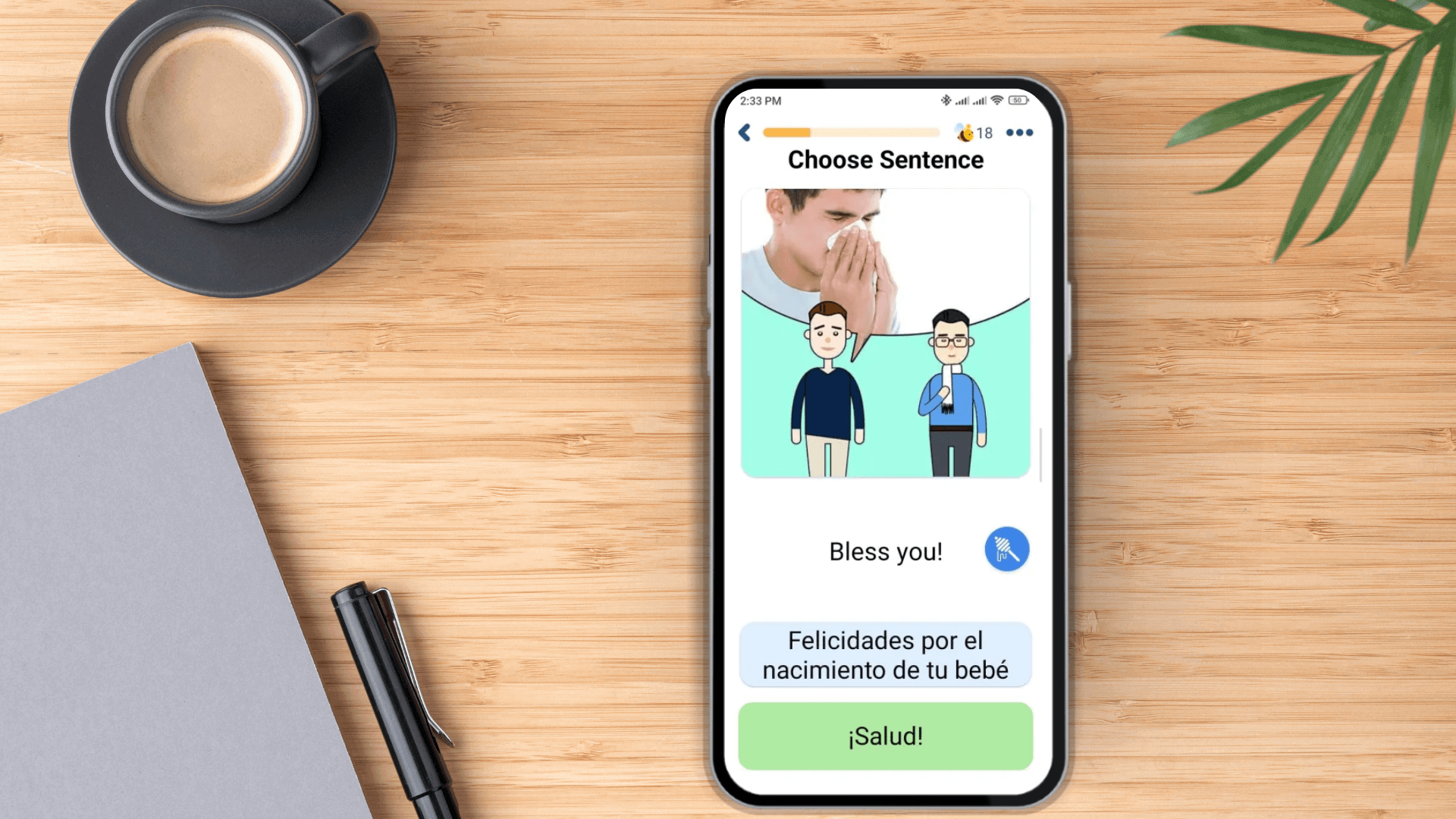
Spanish is one of the world's most popular languages to learn, and an excellent choice in terms of business. With FunEasyLearn, you can speak Spanish confidently in a matter of months. Prepare for almost any situation during your travel to Spanish-speaking countries with over 350 useful topics and subtopics. Set a routine that will perfectly fit your schedule, and stick to it to make real progress.
Premium perks include, but are not limited to, the following:
- Hands-free. Master the Spanish language anytime and anywhere without holding the phone. Just set the order of languages, tap play, and you can review your Spanish vocabulary while walking the dog, jogging, cooking, running errands, cleaning, and more. The feature is beloved by learners of Spanish who are on a tight schedule.
- Favorites. The app lets you create custom lists of words and sentences. That is a convenient option when you need to tailor the content to prepare for a work presentation, an international exhibition, a vacation, or polish up the vocabulary you need more often.
- Review System. Enhance retention with a smart system based on the principles of spaced repetition in language learning. What it does is calculate exactly when you need to review your vocabulary to memorize it better. So, when your brain is about to forget a set of words or sentences, you reactivate them in a short review session. As a result, you learn smarter, not harder, and enjoy better results.
Are you ready to learn Spanish?