






When speaking Italian, you may be inclined to default to "Grazie" to express gratitude. While that is the most common way to say "thank you," it's certainly not the only one. Italians use a wide range of expressions to thank someone, ranging from the most formal to the most informal, and from the most emotional to the least. Variety is the spice of life, and the Italian language loves spices that go beyond "Grazie."
Let's learn how to say "thank you" in Italian in various ways and unlock the social currency of Italian politeness.
Grazie
As a learner wishing to say "Thank you" in Italian, "Grazie" is the first word you will learn. It is the most popular way to express gratitude, often used in daily conversations. It works in most cases, is the safest choice, and is also easy to pronounce. One common pattern is "Grazie" followed by a reason.
| Italian | English |
|---|---|
| Grazie per l'invito | Thanks for the invitation |
| Grazie per il consiglio | Thanks for the advice |
| Grazie per il sostegno | Thanks for the support |
| Grazie dell'aiuto | Thanks for the help |
| Grazie dell'ospitalità | Thanks for your hospitality |
| Grazie della gentilezza | Thanks for your kindness |
| Grazie della disponibilità | Thanks for your availability |
| Grazie di tutto | Thanks for everything |
| Grazie di cuore | Thank you from the heart |
| Grazie per essere venuto/venuta | Thanks for coming |
| Grazie per essere passato/passata | Thanks for stopping by |
| Grazie per il regalo | Thank you for the present |
| Grazie per le belle parole | Thanks for the kind words |
| Grazie per gli auguri | Thanks for the wishes/greetings |
"Grazie per" is the most natural structure in everyday Italian. "Grazie dell'" and "grazie della" are more formal, preferred in written communication such as emails and formal letters. "Grazie di" appears with a handful of fixed expressions that have become idiomatic over time.
More than "Grazie"
Italians have many ways to express gratitude. The goal is to intensify and vary the basic "Grazie." Choose the best one based on register, warmth, and social purpose.
| Italian | English |
|---|---|
| Grazie mille | Thank you very much |
| Mille grazie | Many thanks (formal) |
| Grazie ancora | Thanks again |
| Molte grazie | Many thanks |
| Tante grazie | Thanks so much |
| Grazie di cuore | Heartfelt thanks |
| Grazie infinite | Infinite thanks |
| Non so come ringraziarti | I don't know how to thank you (informal) |
| Ti sono grato/a | I'm grateful to you (informal) |
The phrase "Grazie mille" is one of the first choices in everyday informal situations. Its inverted form, "Mille grazie," sounds more formal and is recommended for use in toasts, speeches, and written communication. For repeated thanks, "Grazie ancora" is the best neutral option."Molte grazie" is more emotionally distant than "Grazie mille" and is a less popular way to say "Grazie".
"Tante grazie" is closer to "thanks so much" or "thanks a bunch," often used among friends and close colleagues in semi-professional contexts. Be careful with the inverted form, "Grazie tante," which is used sarcastically, even though it translates the same way."Grazie di cuore" and "Grazie infinite" are intensifiers of the standard "Grazie". "Non so come ringraziarti" is emotionally strong, so use it for important situations rather than everyday small talk.

Speak a new language with confidence!
Build fluency faster with FunEasyLearn — just 10 minutes a day is enough to make real progress.
Formal Ways to Say “Thank You” in Italian
As you may already know, Italians use the personal pronoun "Lei" as a polite form of address. It’s expected in business, for instance, when interacting with customers, as well as with older people or people in authority. Emails and formal communication also must use the polite personal pronoun.
| Italian | English |
|---|---|
| La ringrazio | Thank you |
| La ringrazio molto | Thank you very much |
| La ringrazio di cuore | Heartfelt thanks |
| È molto gentile da parte Sua | That's very kind of you |
| Le sono grato/a | I'm grateful to you (said by a man/woman) |
"La ringrazio" is the formal version, while "Ti ringrazio" is the informal one. The formal one keeps a respectful social distance when it's expected, while the letter is for people you know very well. The informal equivalent of "Le sono grato/a" is "Ti sono grato/a."You can also combine phrases to express deeper gratitude. An example is "Grazie" followed by a sentence such as "è molto gentile da parte Sua." The result is more special than a simple “Thank you,” showing appreciation for someone who made the effort to help you.
When it comes to written communication, such as official letters and emails, Italians capitalize the formal pronouns "La," "Le," "Lei," translated as "you" and "Sua," meaning "your". Although capitalization is often omitted in certain texts lately, the advice is to keep it.
Informal Ways to Say "Thank You"
When speaking with friends, family, younger people, or in casual settings, Italians switch to a more relaxed, informal conversational style. If you want to speak like a local with your new friends, thank them with one of the options below.
| Italian | English |
|---|---|
| Ti ringrazio | I thank you |
| Sei gentilissimo/a | You're extremely kind |
| Troppo gentile | Too kind |
| Davvero gentile | Really kind |
| Ti devo un favore | I owe you one |
"Ti ringrazio" ("I thank you") is the direct informal version of "La ringrazio." The "ti"signals closeness, so you can use it with anyone you'd address as "tu." It is grammatically identical to the formal version but is friendlier and more casual.
When you say "Sei gentilissimo/a" ("You're extremely kind"), it stands for "thank you" without literally meaning that. It rather complements the other person's kindness. "Troppo gentile" ("Too kind") and "davvero gentile" ("Really kind") are short forms of praise that function like a variation of "Thanks." Keep the expression "Ti devo un favore" ("I owe you one") for personal favors that took time and effort.
How to Reply to "Thank You" in Italian
The most universal reply to "Thank you" in Italian is, of course, "Prego." It's the first word a typical Italian would use to say "you're welcome." The Italian vocabulary has more ways to express the same idea, often by saying it's not a big deal.
| Italian | English |
|---|---|
| Prego | You're welcome |
| Di nulla | It's nothing |
| Di niente | It's nothing |
| Nessun problema | No problem |
| Figurati | Forget it |
| Si figuri | Forget it (formal) |
| Ma di che / Ma di cosa | What are you talking about |
| Non c'è di che | Don't mention it |
| Ma va' | Oh, come on |
| È stato un piacere | It was a pleasure |
| Con piacere | With pleasure |
"Di nulla" and "Di niente" are synonyms, as both "nulla' and "niente" translate as "of nothing". Native speakers use them interchangeably. "Nessun problema" is just like the English "no problem" and the Italian phrase fits casual and semi-formal contexts. "Figurati" and its formal version "Si figuri" both mean "forget it," with the sense that it’s not a big deal. "Ma di che" or "Ma di cosa" (literally "but of what") wants to say "What are you even thanking me for?" A similar expression is "Non c'è di che," a version more common in service roles and professional emails.
"Ma va'" is pure, affectionate exasperation around the lines of "Oh, come on, don't mention it." Use it with very close friends to communicate that they don't have to say "thank you" to someone as close as you.
To sum it up, use "Prego" as the default option, "Figurati" for friends, and "Ma va'" or "Ma di che" when thanks feel almost embarrassing.
Master Italian with FunEasyLearn
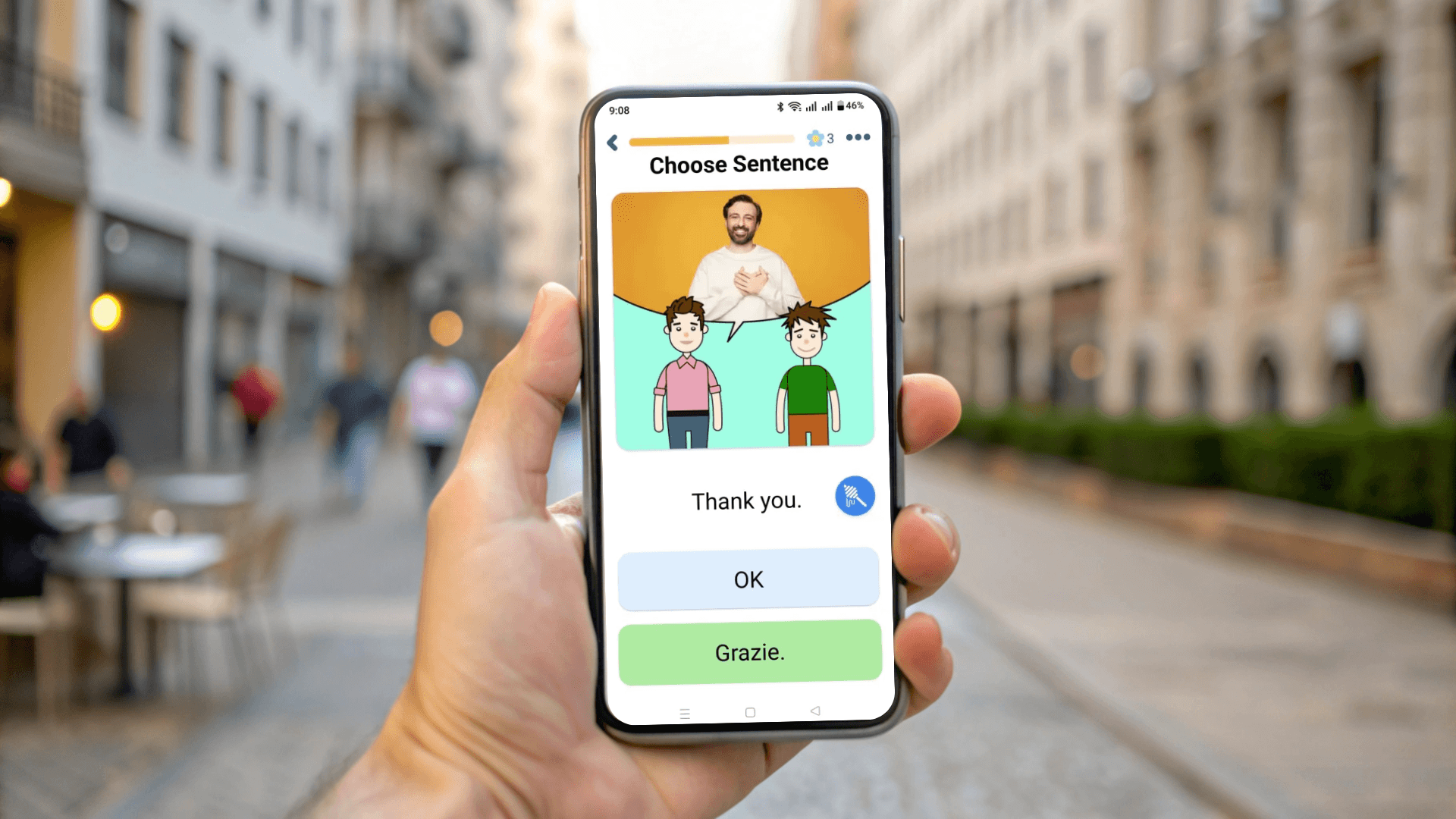
If you want to move beyond "Grazie" and actually speak Italian, FunEasyLearn can help. The award-winning app is trusted by millions of learners worldwide to master new languages through practical, engaging methods. Whether you're preparing for a trip to Rome or building long-term fluency, it provides the structure and tools to learn Italian. Some of the most impressive advantages include the following:
1. Rich vocabulary from day one. The app covers 6,000 words and 5,000 sentences across over 350 topics and subtopics, from airport vocabulary to restaurant conversations. You also get the Italian alphabet with reading rules, so you start reading and speaking correctly from the first lesson.
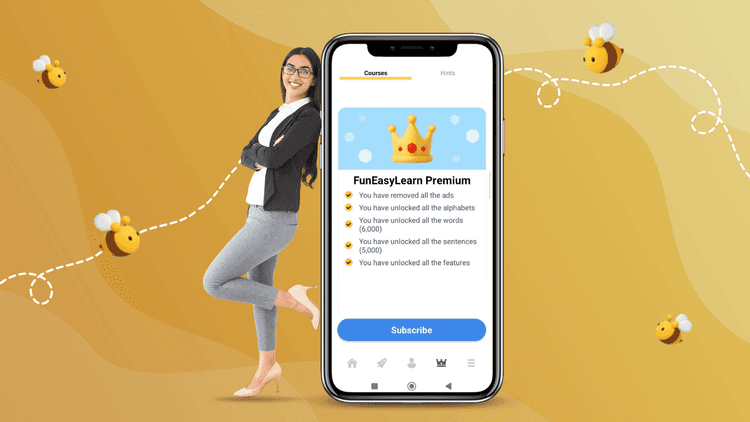
2. Premium tools adjusted to your needs. Upgrading to premium unlocks functionalities such as Search across all topics and subtopics. Premium also enables you to create custom lists of words and phrases with Favorites. Memorize vocabulary faster with the Smart review system, designed around the principles of spaced repetition. Practice Italian anytime and anywhere with the Hands-free mode.
3. A gamified experience that builds habits. Educational vocabulary games train your brain through play. That way, your brain starts to like learning. Friendly reminders, calculated breaks, and streaks help you stick to your daily practice to reach the end goal. Last, but not least, the zero-ads policy creates a distraction-free learning environment. So, instead of clicking through pop-ups, you make the most out of your learning time.
What if you could speak Italian fluently?